
How does commercial real estate and its supporting infrastructure fair amongst all the noise permeating at Rio? asks Andy Szyman, Head of Sustainability at F&C REIT Asset Management.
Agenda 21, the Programme for the Further Implementation of Agenda 21, the Rio Principles, the Johannesburg Declaration on Sustainable Development, the Barbados Programme of Action, the Mauritius Strategy for Implementation, the Bali Conference – each an exotic location associated with an event that might easily be identified from the green activist’s travelogue. Not a meeting in Manchester in sight.
Not surprisingly, there is a lot of scepticism surrounding the Rio+20 UN Conference of Sustainable Development, ranging from the obvious and predictable questioning of the size of carbon footprint generated by the assembly of worldwide delegates in Brazil, to the more searching and pertinent querying on the likelihood and expectancy of meaningful outcomes being delivered.
And perhaps the cynicism is justified. Twenty years since the Earth Summit in Rio, and with numerous conventions in between, the self- same issues remain on the table. No one said it would be easy to address complex issues such as population growth, no one said that the solution to global warming and climate change was simple, and no one suggested that balancing economic growth with restrained consumption was straightforward. Many of these conferences have been characterised by reference to tipping points, to pivotal junctures, to no turning back moments, yet the more these terms are seen and heard, the more natural it is to see them as nothing more than scaremongering sound-bites. The UN General Secretary refers to this coming summit as a once-in-generation opportunity to hit the reset button, although many would be happy to put some currency on a similar future opportunity being available as soon as next year! One might be forgiven for seeing this simply as a hyped-up media circus.
The signs for achieving game changing outcomes are not good. The process of negotiation at inter-governmental level is slow. Of the 330 paragraphs contributing to the Outcomes Document indicating the type of ‘future we want’, only a mere 50 have been agreed following some 34 days of negotiation. Perhaps this is understandable since mankind, countries and diplomats alike are generally hard-wired to survive and prosper, to protect own interests, to look after number one. Whether lengthy discussions and negotiation over the wording of commitments, actions and sentiment are crucial to preserving such interest is debatable. Ultimately, we will end up with some diluted, watered down weasel words which will allow participants to indicate success and justify the occasion, but in the context of the issues and the speed at which they are approaching, one wonders whether this is simply good enough.
So what about commercial real estate and its supporting infrastructure, an asset class that might be seen as a proxy for many of the issues? How does property fair amongst all the noise permeating at Rio? Well, despite the acknowledged significance of this sector, given its key role in providing shelter and facilitating commerce, and the proportion of resource consumption and carbon emissions attributed to it, it is likely to feature directly as well as it did in Copenhagen a few years ago – which was barely a whimper. One short, all embracing, paragraph in the Rio document includes a reference to greener buildings as part of a wider vision for cities and their efficient transportation and communication networks, improved air and water quality, and preparedness to disaster. All very commendable, but vision and commitments, acknowledgements and recognition will not themselves solve the problems faced by our Earth.
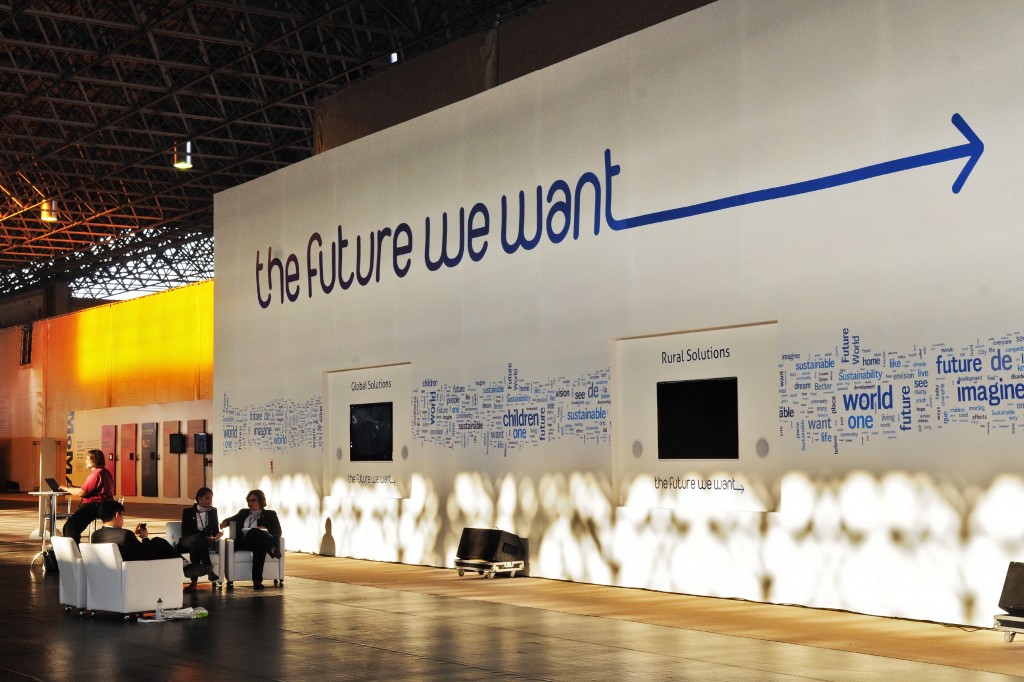
A view inside the dedicated pavilion which sits opposite the Rio+20 conference facilities in Rio de Janeiro, Brazil. The pavilion hosts exhibits and events related to the Rio+20 UN Conference on Sustainable Development and will run parallel to the summit until its 22 June closing. Photo courtesy UN Photo/Maria Elisa Franco